
| Cite Score (2024) | 1.0 | |
| SJR (2025) |
0.294 | |
| SNIP (2024) |
0.251 | |
| SJR | Q3 | |
| MSRT Grade | International | |
| Publication format | Online | |
| Number of Issues | 40 | |
| Number of Articles | 435 | |
| Number of Contributors | 859 | |
| Number of Reviewers | 2560 | |
| Submission Count | 1,665 | |
| Accept Count | 424 | |
| Reject Count | 994 | |
| Acceptance Rate | 25% | |
| Article View | 13401108 | |
| PDF Download | 7,065,820 | |
| Time to Accept (Days) | 109 |
=========================================================
Downloads:
Special issue infographic poster (PDF format)
Special issue infographic poster (JPG format)
Special issue call for papers (PDF format)
Special issue call for papers (JPG format)
=========================================================
CALL FOR PAPERS
Special Issue on
Machine Learning in Numerical Analysis and Optimization:
Theory and Computation
Iranian Journal of Numerical Analysis and Optimization (IJNAO)
|
Scopus Indexed • Indexed in DOAJ and zbMATH Open • No Article Processing Charge (APC) • Open Access |
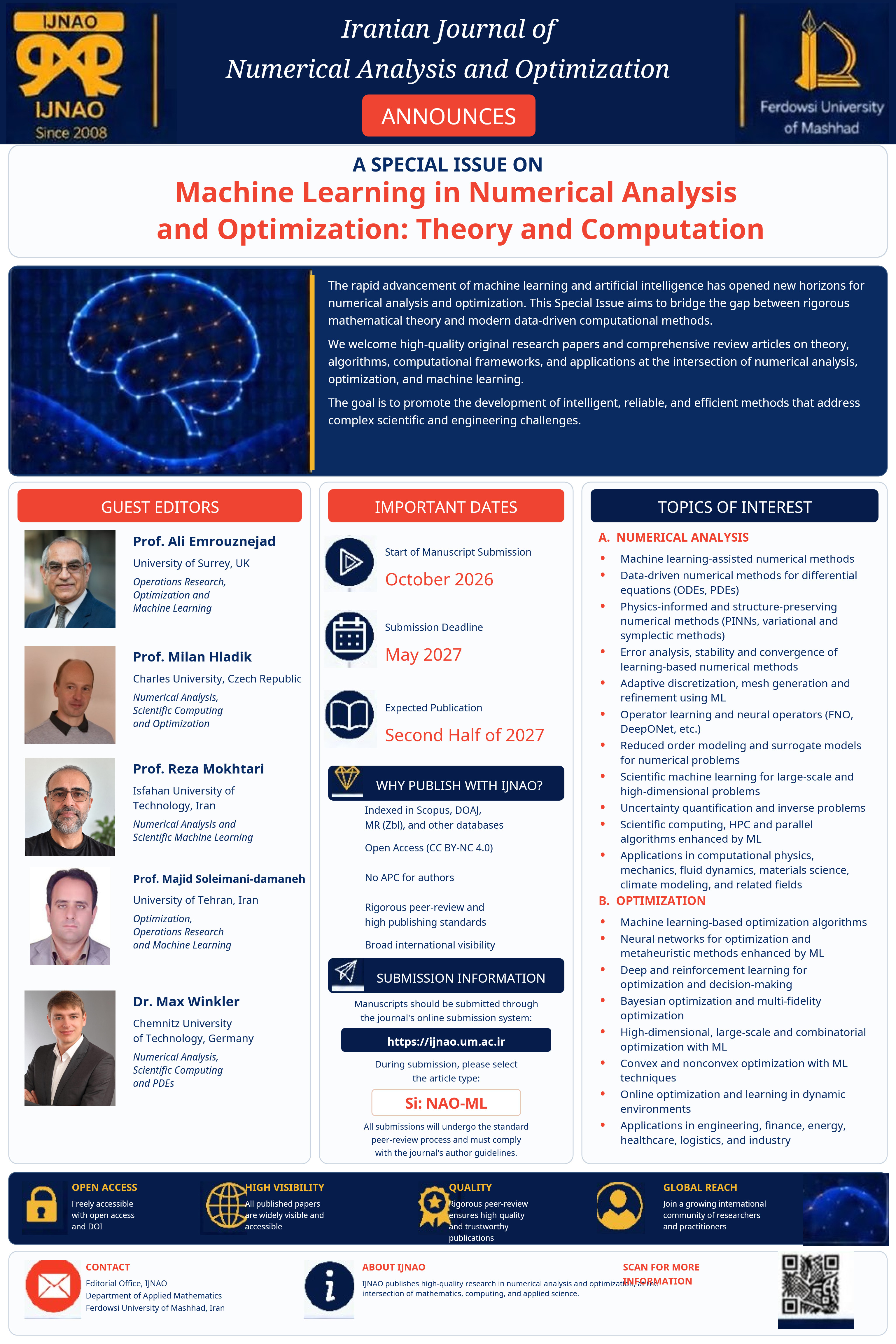
The Iranian Journal of Numerical Analysis and Optimization (IJNAO) is pleased to announce a Special Issue entitled “Machine Learning in Numerical Analysis and Optimization: Theory and Computation.”
The rapid development of machine learning and artificial intelligence is creating new opportunities for the design, analysis, and implementation of advanced numerical and optimization methods. At the same time, numerical analysis and mathematical optimization provide essential theoretical foundations for assessing the accuracy, stability, convergence, robustness, efficiency, and reliability of learning-based computational methods.
This Special Issue focuses on recent theoretical, methodological, and computational advances in machine learning for numerical analysis and optimization, with particular emphasis on mathematically grounded, reliable, and efficient approaches for scientific computing.
We welcome high-quality original research articles, methodological contributions, and comprehensive review papers presenting new theoretical results, numerical algorithms, computational frameworks, or applications. Contributions that combine machine-learning techniques with established numerical or optimization methods, as well as those providing mathematical analysis of learning-based computational approaches, are particularly encouraged.
|
Professor Ali Emrouznejad Director of the Centre for Business Analytics in Practice Surrey Business School University of Surrey, UK |
Professor Milan Hladík Numerical Analysis, Scientific Computing & Optimization Charles University, Czech Republic |
|
Professor Reza Mokhtari Numerical Analysis, Scientific Machine Learning Isfahan University of Technology, Iran |
Professor Majid Soleimani-damaneh Optimization, Operations Research & Machine Learning University of Tehran, Iran |
|
Dr. Max Winkler Numerical Analysis, Scientific Computing & PDEs Technische Universität Chemnitz, Chemnitz, Germany |
|
Topics of interest include, but are not limited to:
· Machine learning-assisted numerical methods
· Scientific Machine Learning (SciML)
· Neural networks for numerical computation and approximation
· Physics-informed neural networks (PINNs) and related methods
· Neural operators and operator-learning methods, including DeepONet-type approaches
· Data-driven numerical methods for differential and integral equations
· AI-accelerated methods for integer- and fractional-order ODEs, PDEs, and integral equations
· Mathematical analysis of learning-based numerical methods, including error analysis, stability, convergence, and robustness
· Numerical approximation and approximation theory for machine-learning models
· Adaptive, multiscale, and data-driven discretization methods
· Machine learning for mesh generation, refinement, and adaptive computation
· Numerical linear algebra combined with machine learning
· Iterative solvers, preconditioning, eigensolvers, and low-rank methods enhanced by learning
· Tensor methods and high-dimensional numerical computation
· Reduced-order models and surrogate modeling
· Inverse problems, parameter identification, and data assimilation
· Uncertainty quantification and Bayesian computational methods
· High-performance and parallel scientific computing enhanced by machine learning
· Learning-based optimization algorithms
· Machine learning for mathematical programming and numerical optimization
· Machine-learning-enhanced metaheuristic algorithms
· Deep learning and reinforcement learning for optimization and decision-making
· Automated algorithm selection and parameter or hyperparameter optimization
· Large-scale and high-dimensional optimization using machine learning
· Convex and nonconvex optimization with learning-based techniques
· Bayesian optimization and multi-fidelity optimization
· Optimization under uncertainty
· Large language models (LLMs) for numerical computation, mathematical reasoning, algorithm design, solver selection, and optimization
We also consider novel applications in computational physics, engineering, finance, healthcare, energy, climate modelling, logistics, and other scientific and technological fields. We particularly encourage studies supported by sound mathematical formulation, theoretical analysis, numerical validation, or demonstrable computational advantages, rather than purely empirical applications of standard machine-learning techniques.
Authors should submit a cover letter and manuscript via the journal’s online submission site. Manuscripts submitted after the deadline may not be considered for the special issue and, if accepted, may be transferred to a regular issue.
Please see the Author instructions on the website. When submitting, please select the special issue’s title “SI: NAO-ML” to ensure that it will be reviewed for this special issue (https://ijnao.um.ac.ir).
Submitted papers must be original and should not have been previously published or currently under consideration for publication elsewhere. All papers will undergo a rigorous peer review process managed by the Guest Editors. Accepted papers will be published online individually before the print publication.
|
Date |
Milestone |
|
1 October 2026 |
Submission open |
|
31 May 2027 |
Submission close |
|
31 July 2027 |
Notification of status and acceptance of paper |
|
30 September 2027 |
Revised manuscripts |
|
31 October 2027 |
Final version of paper |
Submission website: https://ijnao.um.ac.ir
Early submission is recommended: the referee process starts once the paper is received; accepted papers will be published individually online as they are accepted.
==============================================================================
The Iranian Journal of Numerical Analysis and Optimization (IJNAO) publishes original papers of high scientific value in all areas of numerical analysis and optimization. All research articles accepted and published by IJNAO are immediately freely available online to read, download, and share, without any subscription charges or registration barriers.


Pages 1-24
10.22067/ijnao.2026.97038.1812
Mehdi Fazli
Pages 25-44
10.22067/ijnao.2026.99453.1899
Mehdi Lotfi, Azizeh Jabbari, Reza Rahbarghazi, Hossein Kheiri
Pages 45-71
10.22067/ijnao.2026.98442.1865
Mohsen Esmaeilbeigi, Roberto Cavoretto
Pages 72-108
10.22067/ijnao.2026.96859.1794
Salaheddine Belhdid, Habib Hassouni, Oumaima Aarabate, Omar Balatif
Pages 109-144
10.22067/ijnao.2026.98939.1878
Govind Prasad Sahu, Amit Singh Thakur, Chhatrpal Singh Sikawar, Harkaran Singh
Pages 145-176
10.22067/ijnao.2026.99035.1883
Ayomi Sasmito, Camelia K H, Rosa Maeni
Pages 177-216
10.22067/ijnao.2026.98719.1868
Idowu Oluwarimi Joshua, Kiruthika K, Mehmet Gümüş, Ali Raza, Chandrakumar E, Jeeva N
Pages 217-246
10.22067/ijnao.2026.97683.1832
Ayodeji Quadri Akinsanya
Pages 247-272
10.22067/ijnao.2026.99197.1889
Khoa Nguyen Minh, Le Trong Phuoc Bui, Van Thang Tran
Pages 273-289
10.22067/ijnao.2026.97045.1806
Loubna El houari, Mariem Elkaf, Jaouad Danane
Pages 290-331
10.22067/ijnao.2026.97941.1852
Kaushal Soni, Sanjeev Kumar, Shyamsunder Kumawat, Arvind Kumar Sinha
Pages 332-358
10.22067/ijnao.2026.99592.1903
Chalabia Tebbal, Mounia Laouar, Raouf Ziadi, Abd Elhamid Mehamdia
Pages 359-379
10.22067/ijnao.2026.97071.1808
Narges Bidabadi
Pages 380-415
10.22067/ijnao.2026.100294.1934
Tuhfatul Janan, Fatmawati Fatmawati, Agus Hasan
Pages 416-456
10.22067/ijnao.2026.97215.1817
Oludare Adedire, U. W. Sirisena
Pages 457-493
10.22067/ijnao.2026.96965.1802
Hajar Alimorad, Alireza Fakharzadeh Jahromi, Mina Goodarzi
Pages 494-528
10.22067/ijnao.2026.99100.1885
Soukaina IBNOU KADY, Adil Meskaf, Karam Allali
Pages 529-569
10.22067/ijnao.2026.100313.1935
HABIB HASSOUNI, AMINE El Bhih, OUMAIMA AARABATE, OMAR BALATIF
Pages 570-602
10.22067/ijnao.2026.100432.1943
Zakaria Yaagoub
Pages 603-628
10.22067/ijnao.2026.96953.1800
Hossein Hassani, Zakieh Avazzadeh, Arzu Turan-Dincel, Haneyeh Farahmand


